
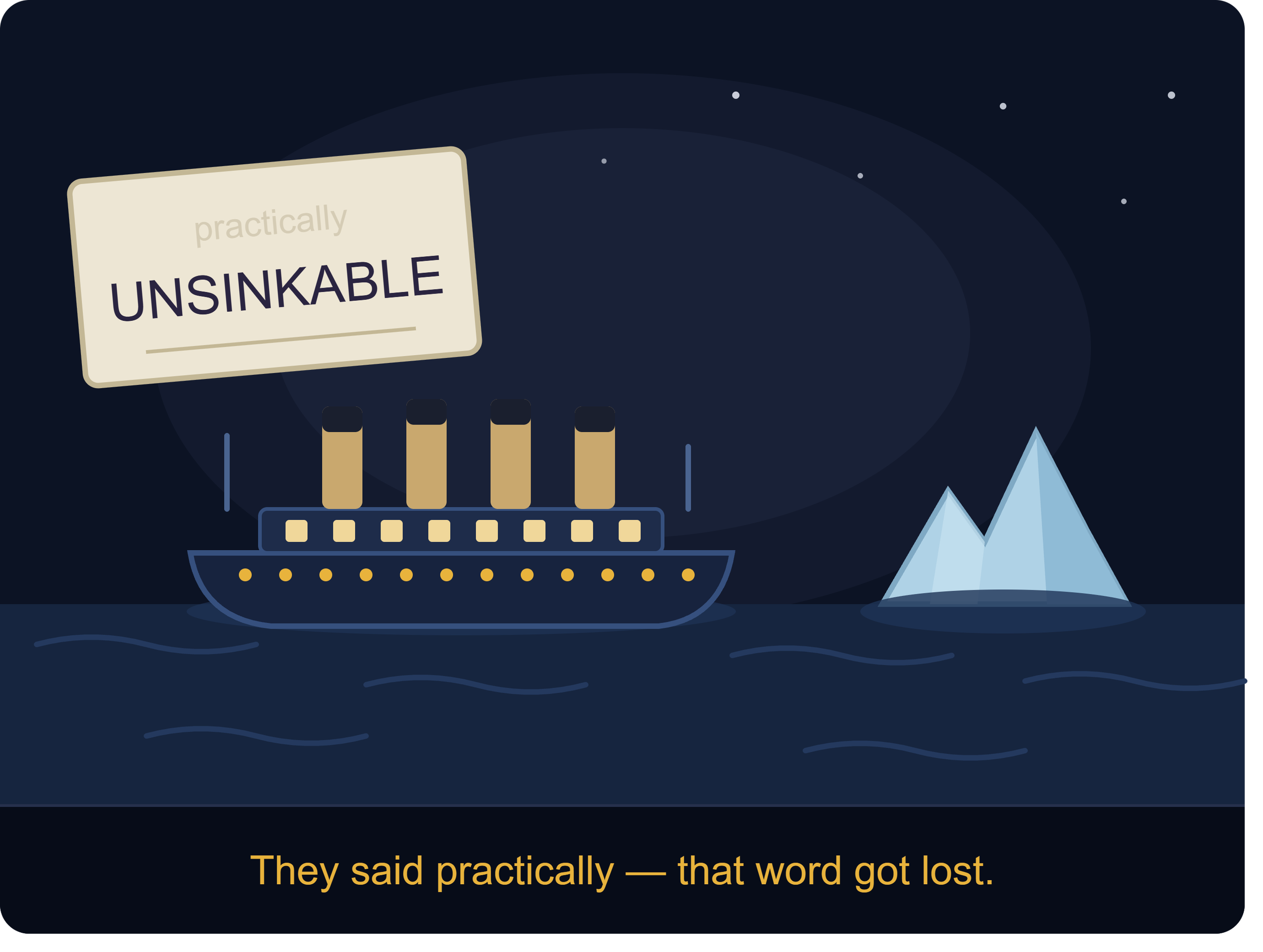
You watch a documentary about the Titanic. The heavy ship with its upper hull being a pitch black and lower hull being red. The pretty color scheme known as White Star Line livery. You watch how people act out going on to the Titanic, excited to travel. You then watch them leave the port and set sail. You then see the rest of the events the Titanic has faced then it was the end of the documentary. “Why didn’t they mention that the Titanic was unsinkable,” you ask your teacher. “Well it was never called unsinkable,” your teacher responded annoyed, without looking up. You were confused then you wonder, was the Titanic called unsinkable before it sailed? Let’s pop this balloon to find out!
What is the Titanic?
The Titanic was a British passenger liner that sank on its first voyage. It was built in Belfast by Harland and Wolff for the White Star Line and was the largest ship afloat at the time, measuring about 882 feet long. It left Southampton, England on April 10, 1912, bound for New York City, carrying roughly 2,200 passengers and crew. Four days later, at about 11:40 at night on April 14, it struck an iceberg in the North Atlantic. The collision opened a long gash along the starboard side, flooding several watertight compartments at once — more than the ship was designed to survive. It sank in about two hours and forty minutes, in the early hours of April 15. Around 1,500 people died, in large part because there were lifeboats for only about half the people aboard, which met the regulations of the time. The wreck was lost for more than seventy years until Robert Ballard located it on the seabed in 1985, roughly two and a half miles down. The disaster led directly to new maritime safety rules, including enough lifeboats for everyone on board and a 24-hour radio watch.
Was the Titanic called unsinkable before it sailed?
This myth is half-true. The White Star Line brochure from 1910–11 described the watertight doors and said the design made the vessel “practically unsinkable.” The magazine then shortened this to just “practically unsinkable.” Bruce Ismay, the White Star chairman, testified afterward that the ship was looked upon as practically unsinkable, “a lifeboat in herself.” The Titanic was described as unsinkable, but never advertised as it. White Star has always maintained the brochure said the ships were designed to be unsinkable, not that they were. Harland and Wolff, the builders, never claimed it at all. “Practically unsinkable” wasn’t even about the Titanic specifically. Shipbuilder was describing watertight compartments as usual in White Star ships, and the same claim was made for the Olympic and Cunard’s Mauretania. One adverb went missing and a myth was born.
Fun Facts
The Titanic had two sister ships — the Olympic, and one meant to be called Gigantic, later renamed Britannic. The ship was designed to stay afloat with four watertight compartments flooded. The iceberg opened more than that. The Titanic carried about 6,000 tons of cargo, including automobiles and artworks.